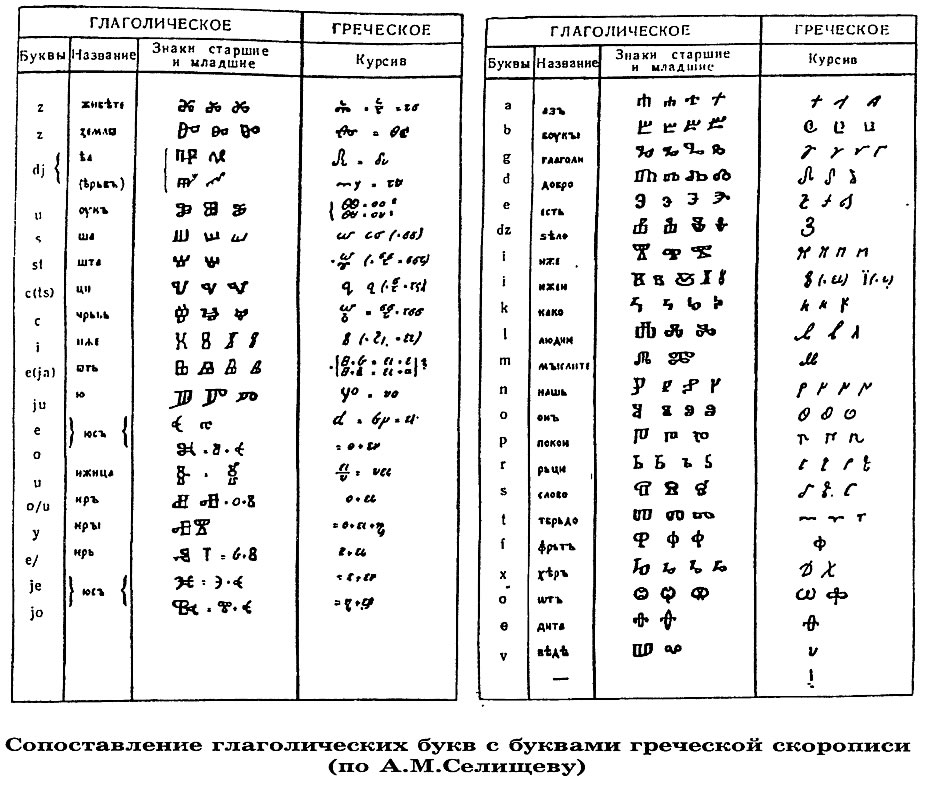
Interestingly, it was also a derivative of Greek, but the cursive version. It's harder to write, but apart from that, I like it. Ⱂⱃⰺⰲⰵⱅ, ⱂⰺⱎⰺⱅⰵ Ⰳⰾⰰⰳⱁⰾⰺⱌⰵⰻ!
This is a novel claim to me. I don't think Glagolitic looks particularly like cursive Greek, and I haven't seen this idea in scholarship. What is your source for it?
I guess I don't see this idea around because it wasn't good enough to survive the early 1950s? I am looking at the tables, and while I can see the resemblance in some places, it's quite a significant stretch in others. The fact that the Glagolitic and Greek examples are cherry-picked from different manuscripts with different styles doesn't help.
This author is suggesting that Cyrillic is a sort of tool or weapon in the arms of the authority, and is imposed upon the people for purely political reasons. This is just false projection of modern politics onto old times. It's shameless propaganda.
In reality, at the time, it was the Eastern Christian church that was more liberal than Rome. Rome insisted every local church make services in Latin, and didn't translate it in the local language.
The Eastern church instead, had the bible in Greek, but allowed to translate it in local languages and make services in them. Initially, those translations were made with Greek letters, which weren't fully reflecting the phonology of Slavic and other languages, so they were extended, which produced Cyrillic.
As I understand, the same way Coptic script in Egypt, and Ge'ez in Ethiopia were made, thanks to Eastern Christian church allowing this.
p.s. Saint Cyril, in fact, invented the Glagolitic script. Cyrillic was named after him, and initially "Cyrillic" alphabet was mostly Greek, plus some characters from Glagolitic, like Ⱎ, ⱍ and ⱑ.
Cyrillic has been indeed frequently used as a weapon, even if usually not by the Church, but by Tsars or by the Soviet state. Even the Eastern Christian Church, while it allowed various local alphabets, most of which were derived from the Greek alphabet, it was much less tolerant with the Latin alphabet or anything else that could be influenced by the Catholic Church, which was seen as a hostile competitor.
The Russians have forced most of the people they have subjugated (except for the 3 Baltic countries) to switch their writing system to Cyrillic, regardless whether they had previously used Latin, Arabic or other alphabets. This happened both during the time of the Russian Empire and of the Soviet Union.
This was very intentional, to make difficult for the younger people to read any books from before the Russian occupation, if they succeeded to find such books.
This was coupled to a system of education were people were taught in schools a falsified history, were the Russian invaders were presented as liberators and where it was claimed that everything good in science and technology had been discovered or invented by some unknown Russians instead of those about whom the Western "imperialists" say that they were the discoverers/inventors.
Funnily, you don't know or omit the details yourself.
Russian Empire didn't give the conquered nations the alphabet, but USSR did, as part of supporting local nationalists (surprize!). And it first gave them the Latin script.
Secondly, using different scripts for the same language isn't hard. Serbs use both Cyrillic and Latin interchangeably, and many people used Latin traslit in computers and phones when their codepages weren't available yet, and it wasn't a big problem. It takes you at most 2 weeks to learn Arabic script without knowing the language, and with own language of slightly older version, it's even easier.
You also suggest Arabic is their "proper" language, but abjad is not suitable for Turkic languages -- there vowels are significant, and many more than the 3 Arabic vowel diacritics. They had actually Turkic runes instead. Why don't you bash Arabic too?
What about Germanic peoples? Was switching to Latin from their runes an evil oppression?
It is military force and administration, that set school curriculum, use a certain script, and teach an edited history. Not the Cyrillic.
> Russian Empire didn't give the conquered nations the alphabet, but USSR did, as part of supporting local nationalists.
Many languages of Russia got their alphabets already in the late nineteenth century or around the 1906 rebellion. If you look at publications then in Mari, Chuvash, Ossetic, etc. the Cyrillic orthography already has most of the special characters that were used in the Soviet era. (Moreover, many of these languages never had a Latin-alphabet phase.)
But in the USSR, official doctrine required crediting the Bolsheviks with the development of minority-language writing, and it became taboo to mention all the pre-1917 developments. Only around the time of glasnost and perestroika was this era revisited in Soviet scholarship, but many ordinary Russians remained unaware they had been taught a myth.
Your claims elsewhere here about Uzbek are out of date. I have traveled extensively in UZ and, as an OSM mapper, I am constantly looking at signage. There is exceedingly little Cyrillic left in most of the country. So little that when one spots it, it seems a bit of a novelty.
The Latin alphabet and some local alphabets were allowed for some years after the formation of the Soviet Union, but eventually during the thirties Stalin has started the Cyrillisation by force of most of the Soviet republics. Any opponents were deported to forced labor in Siberia or killed.
After the dissolution of the Soviet Union, most of the former non-Slavic members have abandoned the Cyrillic alphabet previously forced upon them.
They're just 3 states, and they have 0 texts from pre-Cyrillic period in the Latin alphabets they came up with.
Azeri language is similar to Turkish, it's an easy job, and they can watch Turkish media with no issues, and there's an infinite corpus of Turkish texts for them.
For Uzbekistan and Turkmenistan the situation is that they used Arabic script before the Soviet times. There are no texts in the Latin they chose, and their scripts and languages are far from Turkish.
If you walk down the street in Tashkent, there are signs and even announcements in Cyrillic, even in public schools. It takes long to take off, and it's probably 2nd if not 3rd version of Latin.
And also, they teach Russian in Uzbekistan too, and watch Russian media, and share political views. You must have good imagination to suggest that the switch to Latin de-colonized them.
In Kazakhstan, Latin was pet project of the former president, and is currently abandoned.
I wonder, what's your take on your alternative scripts. Latin was enforced by Roman catholic church. Poor Germanic peoples! Muslims enforced their Arabic abjad on Indo-European Farsi, where abjad doesn't quite fit.
All these alternatives have a history of bloody colonialism. Any better options?
> The Russians have forced most of the people they have subjugated (except for the 3 Baltic countries) to switch their writing system to Cyrillic, regardless whether they had previously used Latin, Arabic or other alphabets. This happened both during the time of the Russian Empire and of the Soviet Union.
Missing context:
What you’re talking about is Likbez - Soviet program to eliminate illiteracy started as soon after the revolution in 1917 that overthrew the tsar as the majority of the population was in fact illiterate, at around 23% or so literacy.
So you’re saying that they re-educated an illiterate population to stop writing in their native alphabet and instead in Cyrillic? In forced re-education camps?
Cyrillic has been used as a political weapon under the Soviet Union.
For example, in soviet Moldova it was mandatory to learn to read and write cyrillic at schools. They effectively wanted to eradicate the local language and culture in favor of russian.
No, you're wishfully thinking. What made people absorb the Soviet version of history and politics, was school curriculum, and central TV, and teaching Russian to keep them in orbit. Cyrillic alone won't allow this.
It was one of multiple tools that were used to reinforce each other. The alphabet, of all things, obviously plays a huge role in cultural indoctrination and assimilation. You're being strangely defensive about this.
Oh, yes, the alphabet is used to write texts to convey evil empires' messages! Why am I so strangely defensive, really? Well, it's the most ridiculous argument people use here. Somebody is conquered, governed -- you may say colonized, -- there's army and police, but you all are pointing at the alphabet.
Like, if you're on the USA/Israeli side in the current conflict, well, maybe quit using Arabic numerals, switch to Roman?
I guess, there's another set of tranformations in stories.
At least in European culture, stories lost their religious part in the modernity. Probably people stopped understanding it earlier, but they were transformed in the XIX century. For example, a knight didn't serve a lady in medieval literature -- he served the god. Some story had a knight standing on his knees in lady's sleeping room, of course, having no sex, nor kisses -- not because of "romantic" self-denial, as we would think -- but just because they were praying. They were busy saving their souls before the judgement day. In the Enlightment age, people stopped understanding this, and replaced it with purely romantic motivation.
The other stories, that villagers told their kids, were probably to scare them, about the dangerous world around. The characters were motivated purely by the need to survive, and minding their own business, no high moral goal. In XIX century, with steam locomotives and boats, people could travel to unthinkable places, and many moved to cities, so you couldn't scare kids with a witch or a werewolf living in that forest beyond that lastmost house. So, storytellers invented the adventure genre. So, instead of trying to survive, characters go far away on purpose, where they need to fight to survive. Or there are some unknown human villains, who the good character has to fight.
In late XX century, this story becomes unconvincing too. Big villains and monsters are unimaginable, so stories start breaking this pattern, often demonstratively: here's a monster, ugly and huge, the little boy is scared of him, but suddenly the monster turns out nice, and loves dancing walzer or makes sweet pancakes, and they become friends. Soviet cartoons in the 80s were 100% postmodernist, whilst what I saw of the American ones, were still like 80% modernist -- the bad guys, danger, the righteous main character.
>. For example, a knight didn't serve a lady in medieval literature -- he served the god.
Uhm, 50/50. Bear in mind Don Quixote made fun on the old farts from the Middle Ages saving "damisels" in distress. Sancho Panza was the simple, new man but far more grounded than Alonso Quijano which could be depicted as the last living "priest" because since 1492 no one gave a shit about kingdoms, local lords or whatever; everyone wanted to go to The Americas for a quick fortune (either by selling goods, or getting many more times food than in Spain).
>So, storytellers invented the adventure genre.
The adventure genre was what people liked before the mentioned Don Quixote, not by reading, but from folk tales, which are older than dirt, especially if you lived by the coast and met sailors around.
>this story becomes unconvincing too. Big villains and monsters are unimaginable,
Cosmic fears replaced big, concrete monsters (the rapist from the woods) with abstract fears under Lovecraft.
Nietzche depicted the old pre-Industrial values as obsolete. Lovecraft was scared of the new times. Cervantes just made a good laugh on both the "mythical, glorious times" but also on the "dumb, clueless future man".
In the end both idealistic/realist roles learnt from each other across the adventure, which is what happens IRL in societies.
Cervantes was wiser, the laughted at the old fart seeing dangers everywhere against its outdated values, but so did on the new man with no "elevated" purposes.
> The adventure genre was what people liked before the mentioned Don Quixote, not by reading, but from folk tales, which are older than dirt, especially if you lived by the coast and met sailors around.
Well, maybe. I meant the genre like Jules Verne, Robert Stivenson.
Actually, I checked facts and found out that Daniel Defoe (I thought he lived in the same epoch), in fact lived in XVII-XVIII, much earlier.
Well, Verne was half adventure and half science fiction. You might call them "expedition books" with a purpose, because adventure papyres predate Rome.
The Oddysey, Gilgamesh and basically every tribe in the Earth ever. has its own lore about some hero doing an incredible quest
Interesting read, wouldn't have thought this of Pinocchio. Sadly, when I was learning Italian, I was reading more sophisticated things like Il Fu Mattia Pascal, with quite superficial understanding.
Sadly the imperative is, as often, a call to everyone to be good guy and make less noise. Unfortunately, it doesn't work, neither at personal level, nor at global.
One may be quiet, but what if your friend/acquaintance/fellow got possessed by some AI slot machine, and is sharing his "products" enthusiastically? I had such case, and right from the very beginning was dismissive and rude, and it doesn't work -- he keeps sharing various artifacts.
On a global level, yes communities die out. I think, global communication has reached the point when it's more a liability than a benefit. In late '90s and early '00s, maybe until early '10s, getting more connected could lead you to nice clients, getting hired etc. Nowadays, even before ChatGPT 3 in '22, every such area became overcrowded, underbidded, etc, and LLMs, surprisingly, added not much new -- just augmented this trend.
I tried Zed several times, and still VS Code + Sublime win.
1. In Zed, all my Rust files are reformatted on save. (I also code in Go, and don't like this approach at all.)
2. It takes ages to find out where to configure the language servers, and find those little options several layers deep, that I need to switch. (E.g. turn of rustfmt, or turn off some PEP8 checks.)
3. Zed is still missing the killer feature of Rust in VS Code -- underlining the mutable vars. (TBH, VS Code custom themes also lack this, and it's unclear how to turn that feature on, but at least the default ones have it.)
For comparison, I have bought all 4 Sublime editions. I tried Pycharm, and still preferred Sublime. VS Code came when I needed interactive debugger for Rust.
1. That's a pref, turn off "format on save" lots of editors and IDEs have it. Maybe they should default to off but it's not an unheard of option with no way to turn off.
As a user of a folding bike, I don't care that parts stick out of it, but I'll agree it's on the limits of geometry, and folding isn't elegant -- and when it's folded, it's still quite big.


reply